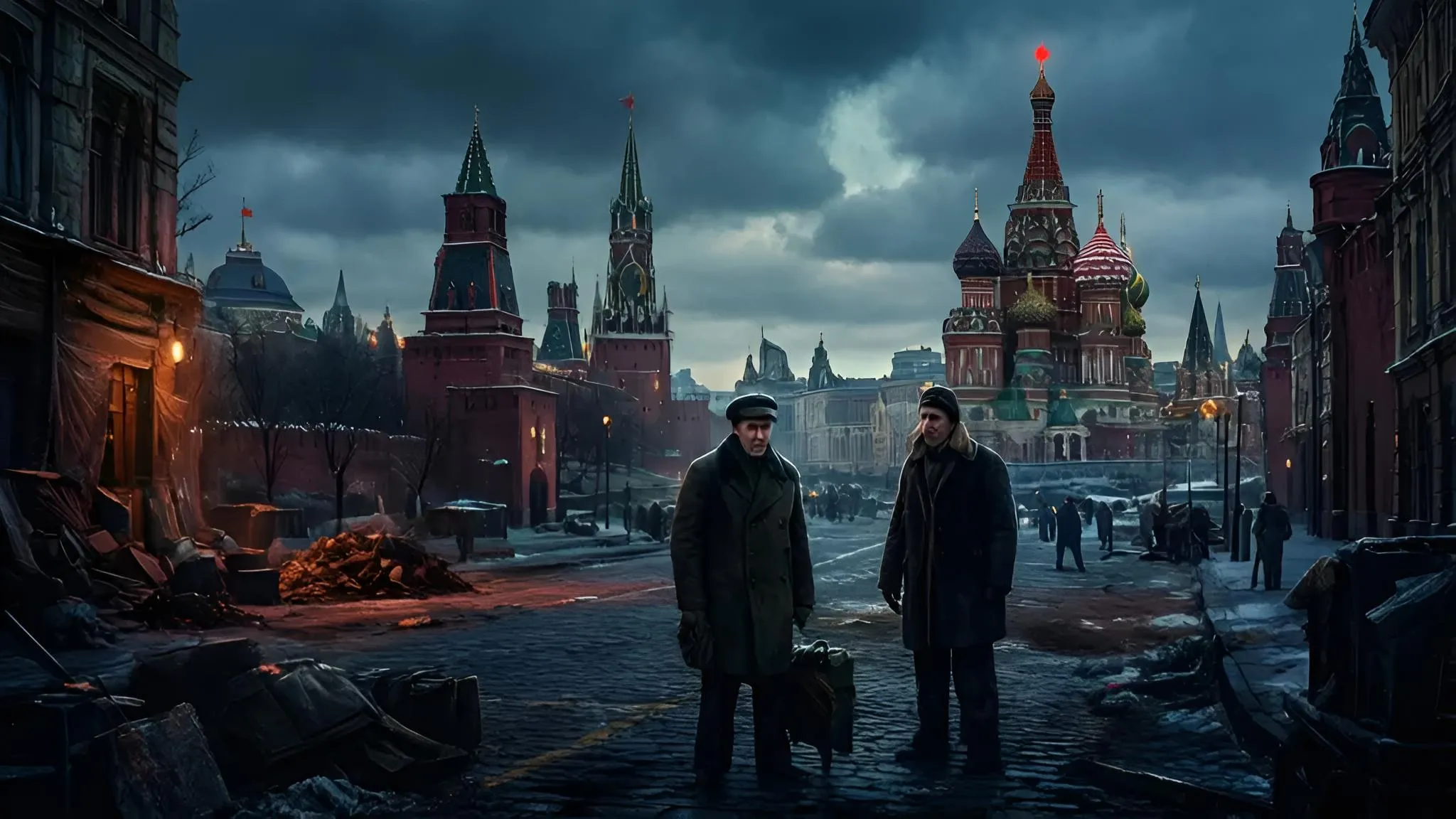
Community world · Moscow City · 1991

Run of the Week

Moscow, 1991

Shortages, whispers, and a Soviet capital that still stands but no longer holds

Moscow, capital of the Soviet Union, two months before its collapse. Ministries still issue orders. Factories still operate. Police still patrol. Yet supply chains fail, authority fractures, and survival depends on access, trust, and timing inside a system that is ending.

Created by mrT

Last Winter cover image

Runs

0

Likes

0

Locations

9

Characters

4

World premise

A playable world seed with consequences.

You are in Moscow, Soviet Union. October 1991. The Kremlin still flies the red flag, the Supreme Soviet still meets. But the August coup has broken confidence in the Soviet government as Republics assert their independence. The ruble weakens, shops open with little to sell, and lines form outside state stores on Gorky Street and in residential districts. People carry bags in case something appears. Everyone senses the same fact - the Union will not survive the winter, even if no one names the date.

Scarcity is pushing ordinary Muscovites into riskier bargains, private trade, workplace theft, side deals, and dependence on unofficial networks.

The militsiya and other authorities are expanding pressure under the language of order, regulation, and anti speculation.

As the Soviet Union nears its end, more people in Moscow begin choosing quietly between loyalty, adaptation, and profit.

Map

Locations

civic center

Red Square

The symbolic heart of Moscow. State ceremonies, public gatherings, and visible power remain, but meaning shifts as authority weakens.

government

Kremlin Complex

Seat of Soviet leadership in Moscow. Orders still originate here, but enforcement grows uncertain beyond its walls.

market

GUM Department Store

A central state store facing Red Square. Lines form early. Stock appears unpredictably. Information spreads fast here.

commercial

Tverskaya Street

A major artery in Moscow. Shops, offices, and movement converge. Public mood is visible in its crowds and queues.

residential

Arbat District

A historic area of Moscow. Apartments, small trade, and street life mix with rising informal markets.

transport hub

Kievsky Rail Terminal

A major entry point into Moscow. Goods, travelers, and rumors arrive together. Delays and shortages are common.

Power

Factions

political · influence 52

Communist Party Hardliners

Officials and loyalists seeking to preserve the Soviet Union and centralized control. Weakened after the August coup, but still present in Moscow institutions.

state faction · influence 70

Reformist Bloc

Officials, deputies, and activists in Moscow pushing for rapid change, market reforms, and a break from Soviet structures. Competing with Union structures for control.

political movement · influence 63

Democratic Russia Movement

A broad coalition in Moscow supporting democratic reform and Russian sovereignty, led by Boris Yeltsin, Active in rallies and public pressure.

informal trade · influence 75

Chernyy Rynok

Loose but powerful groups moving goods outside state control in Moscow. They respond faster than official supply systems.

economic network · influence 61

Cooperative Sector

Semi legal businesses and collectives in Moscow. They operate between state control and emerging market practices.

security · influence 64

Security Service Circles

Networks tied to former KGB and internal security organs in Moscow. They retain influence through information and connections.

Pressure

Opening rumors

Credibility 67

Official whisper

The Russian government is preparing to lift price controls soon, which will make basic goods suddenly unaffordable.

Credibility 54

Metro talk

Officials in Moscow already know the exact date the Soviet Union will formally end, but are keeping it quiet to avoid panic.

Credibility 71

Rail yard gossip

Entire shipments entering Moscow are being quietly redirected by insiders before reaching state stores.

Credibility 62

Barracks rumor

Units near Moscow have unclear orders, and some officers are waiting to see which authority to follow if unrest begins.

Credibility 49

Street gossip

Hardline Party figures are planning another attempt to restore full Soviet control in Moscow before the year ends.

Begin

Start a life inside Moscow, 1991.

More worlds to play

The Old World Order, 1444

The year is 1444; the aftermath of Varna has left crowns trembling and borders fluid. As a sovereign ruler, you must navigate the complex web of dynastic legitimacy, estates of the realm, and burgeoning professional bureaucracies to ensure your nation’s survival.

The Fall of Cadia, 41999

In the final year of the 41st Millennium, Cadia is a world of absolute martial law and grinding industry. As the Thirteenth Black Crusade begins its assault, the populace remains locked in their roles—feeding the war machine, maintaining the great pylons, and bracing for a siege that has defined their lineage for ten thousand years. Beneath the thunder of orbital batteries, ordinary citizens navigate a landscape of rigid quotas, vox-propaganda, and the suffocating presence of the Inquisition.

Berlin, 1942

The year is 1942. Berlin is the political and administrative heart of Germany. Government ministries, railways, factories, cafés, apartment blocks, and military headquarters operate around the clock to support the war effort. While many citizens still believe victory is within reach, rationing, blackouts, the absence of men serving at the front, and growing casualty lists have become part of everyday life. The city is alive with civil servants, railway workers, doctors, shopkeepers, factory employees, students, and soldiers on leave. News from distant fronts shapes conversations, yet most people continue their routines—working, raising families, and adapting to the demands of wartime.

The Modern World of, 1820

A modern world where magic is real and life is comfortable for the main character, who navigates high society, political intrigue, and arcane secrets.

Пыль Ферганы Коканд 1820, 1820

Действуй как продвинутый движок исторической текстовой стратегии. Твоя задача — симулировать мир в реальном времени, основываясь на решениях простолюдина в Кокандском ханстве. Реалистичный стиль с акцентом на геополитику, экономику и случайные события. Выживай в условиях городской тесноты, налогового гнета и политической нестабильности Центральной Азии начала XIX века.

Inicio del personaje Soy, 0

Soy **Kai Enríquez Flores**, chileno de **22 años**. Tengo ojos negros, pelo negro y vivo en la Región del Biobío con mis padres. Tengo autismo de alto funcionamiento, pero estoy correctamente medicado y puedo desenvolverme con normalidad en mi vida diaria. Recibo una pensión mensual de **50.000 CLP**. Mis padres no me piden aportar dinero al hogar. Mi padre es contador y mi madre es artista pintora. ## Primer turno Es el primer mes desde que comienzo a recibir la pensión. Decido invertir los **50.000 CLP** completos en el fondo **Risky Norris A**. Toda ganancia, rentabilidad o rendimiento generado por esa inversión no se retira. En cambio, se transfiere automáticamente a un segundo fondo independiente llamado **Risky Norris A 2**, donde continúa acumulándose por separado. ## Regla de simulación de la rentabilidad No uses rentabilidades reales de Fintual ni del mercado. Usa únicamente esta referencia como regla proporcional: * Inversión: **15.100 CLP** * Ganancia en 1 día: **100 CLP** Para cualquier otro monto invertido, calcula la ganancia usando una **regla de tres simple**, manteniendo exactamente la misma proporción. Además, muestra siempre: * Ganancia estimada por hora. * Ganancia estimada por día. * Ganancia estimada por semana. * Ganancia estimada por mes (30 días). * Ganancia estimada por año (365 días). La simulación debe actualizar el capital invertido y el saldo acumulado del fondo **Risky Norris A 2** en cada turno utilizando esta misma regla proporcional.